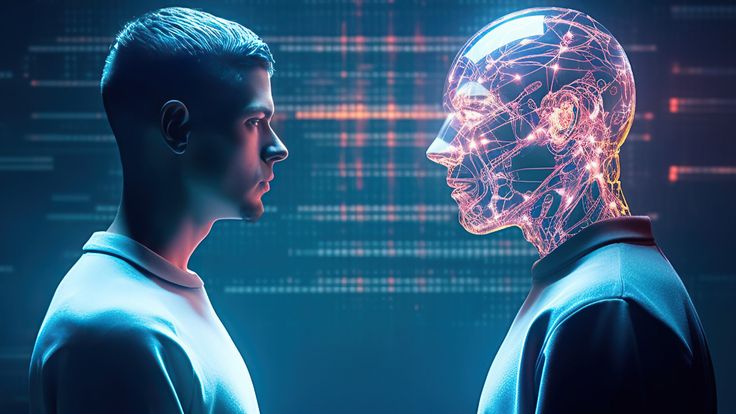
Artificial Intelligence has rapidly stepped into territories once believed to belong exclusively to humans. It writes essays, composes music, designs logos, edits films, builds websites, and even generates realistic artwork within seconds. Tasks that once required years of training, talent, and practice can now be initiated with a simple prompt.
This transformation has sparked one of the most fascinating debates of our generation: Can AI truly compete with human creativity — or even surpass it?
This is not just a technical question. It is philosophical. It is emotional. It challenges our understanding of what makes us uniquely human.
Understanding Human Creativity
Human creativity is deeply connected to consciousness, emotion, and lived experience. When humans create, they do not simply combine patterns — they express identity.
A novel may reflect heartbreak. A painting may capture nostalgia. A piece of music may represent personal struggle or cultural history. Human creativity carries emotional memory.
It is influenced by:
- Personal experiences
- Culture and upbringing
- Beliefs and values
- Emotional states
- Social environments
Creativity in humans evolves over time. A person at 40 does not create the same way they did at 18. Growth, maturity, and life lessons shape artistic expression.
How AI “Creates”
Artificial Intelligence does not experience life. It does not feel joy, fear, excitement, or heartbreak. Instead, it analyzes massive datasets and identifies patterns within them.
When AI generates content, it predicts the most statistically probable outcome based on what it has learned from data.
For example:
- Text models predict the next word in a sequence.
- Image generators predict visual patterns based on training images.
- Music generators combine learned melody and rhythm structures.
AI does not create from memory — it generates from probability.
Speed and Productivity: AI’s Clear Strength
In terms of speed, AI dominates without question.
A writer might spend hours drafting an article. AI can generate structured content in seconds. Designers can create multiple variations instantly. Developers can debug code rapidly with AI assistance.
This scalability has made AI extremely valuable in:
- Digital marketing
- Content production
- Game development
- Software engineering
- Advertising
For businesses, this efficiency translates into cost savings and faster innovation cycles.
Emotional Intelligence: The Human Advantage
While AI excels in efficiency, human creativity holds the advantage in emotional intelligence.
Humans create with intention. They create to communicate meaning, to heal, to challenge, to inspire. Emotional authenticity cannot be fully simulated.
An AI-generated poem may sound beautiful, but it does not come from lived sorrow. A human-written poem carries genuine emotional context.
Audiences often connect deeply with art when they sense human vulnerability behind it.
Originality and Innovation
True innovation often comes from breaking rules — not following patterns.
Human creativity has produced revolutionary movements in art, science, and philosophy. These breakthroughs often emerged from rebellion, risk-taking, and challenging existing systems.
AI, however, operates within the boundaries of learned data. It recombines patterns but does not independently rebel against them.
Creative Risk-Taking
Risk is a major part of creativity. Humans take creative risks because they feel ambition, fear, hope, and desire for recognition.
AI does not take risks. It optimizes for probability.
Many groundbreaking human achievements were considered “wrong” or “strange” at first. Creativity often thrives in uncertainty.
Ethical and Philosophical Questions
The rise of AI creativity raises important ethical questions:
- Who owns AI-generated content?
- Should AI replace creative professionals?
- Is machine-generated art authentic?
- How do we prevent bias in AI systems?
These concerns show that creativity is not just technical — it is deeply tied to morality and identity.
Human-AI Collaboration: The Future Model
Instead of viewing AI as competition, many experts see it as a collaborative partner.
Writers use AI to brainstorm ideas. Designers use AI to test early concepts. Musicians experiment with AI-generated melodies. Developers use AI for code suggestions.
In this model, AI handles repetitive and technical tasks while humans focus on:
- Vision
- Strategy
- Storytelling
- Emotional depth
- Critical thinking
Creativity in the Age of Automation
We are entering an era where creativity becomes more strategic than mechanical.
Instead of asking “Can AI replace humans?” the better question may be:
How can humans use AI to expand creative boundaries?
Just as photography did not eliminate painting and digital editing did not eliminate filmmaking, AI may simply redefine the creative process.
Economic Impact on Creative Industries
There is legitimate concern about job displacement. Freelance designers, writers, and illustrators worry about automation.
However, history shows that technological shifts often create new roles even as they transform old ones.
New opportunities may include:
- AI prompt engineering
- Creative AI supervision
- Human-AI workflow design
- Ethical AI consulting
Can AI Ever Become Truly Creative?
The ultimate question revolves around consciousness. Creativity in humans emerges from awareness and subjective experience.
Unless AI develops genuine consciousness — which remains speculative — its creativity will remain fundamentally different from human creativity.
AI can simulate style. It cannot simulate lived reality.
So, Who Wins?
If creativity is measured by:
- Speed → AI wins.
- Scalability → AI wins.
- Pattern generation → AI wins.
- Emotional authenticity → Humans win.
- Intentional meaning → Humans win.
- Original lived experience → Humans win.
The real answer is not a simple victory for one side.
The future belongs to those who combine human imagination with artificial intelligence.
Final Thoughts
AI is not the end of human creativity. It is a new chapter.
Human imagination remains powerful because it is rooted in experience, emotion, and identity. AI enhances productivity and expands possibility.
In the end, creativity does not diminish with AI — it evolves.
The winners will not be machines alone. The winners will not be humans alone. The true winner will be collaboration.
Back